
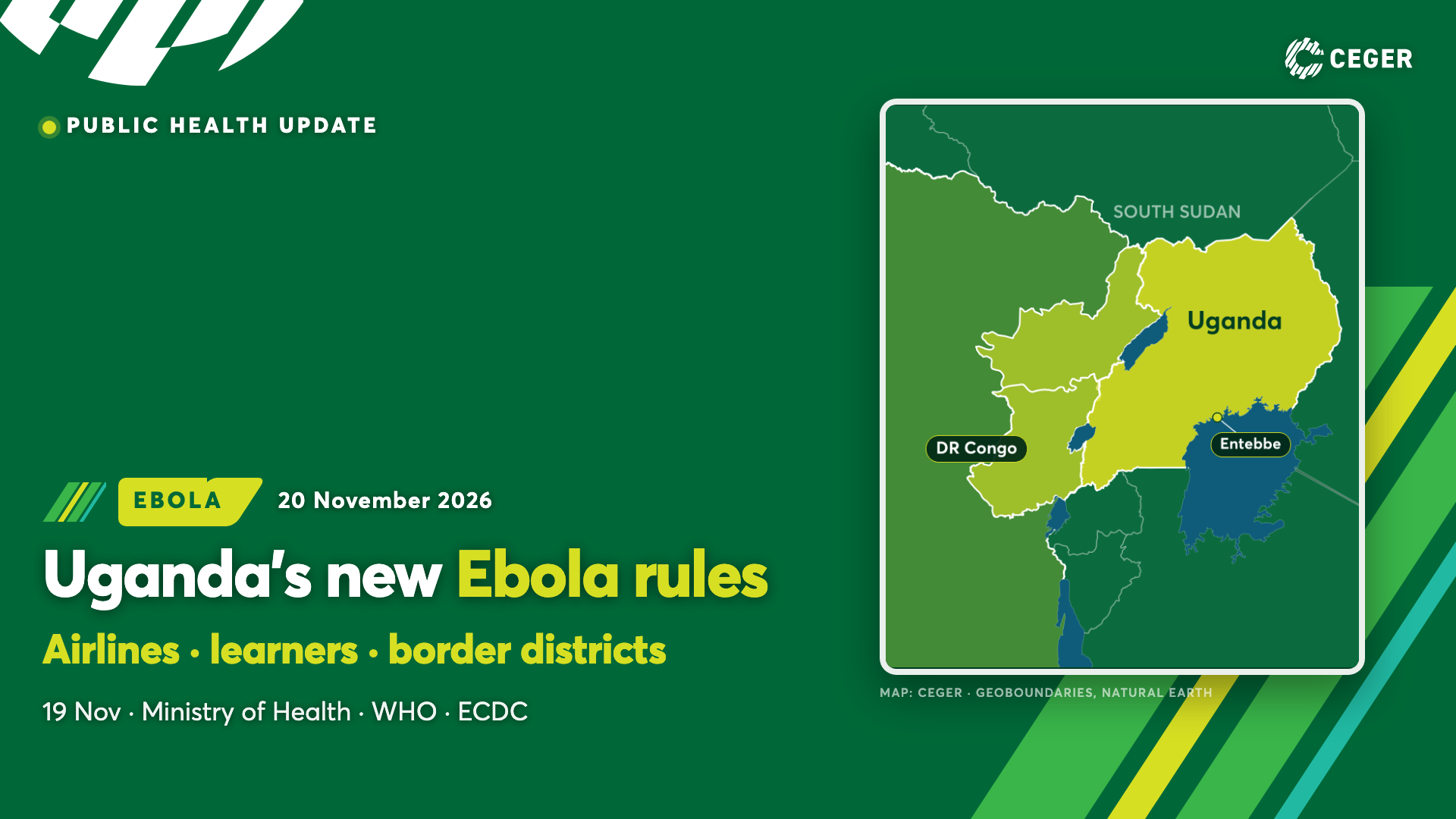
On Thursday 19 November 2026, Uganda’s Ministry of Health announced new Ebola measures that took effect immediately (Daily Monitor; Nile Post). Uganda has had no confirmed case since it declared its own outbreak over on 28 July (Ministry of Health). The measures are aimed at stopping the virus coming in from DR Congo, where the outbreak is still growing.
What changed
- Airlines and transport operators. “Airlines and other operators found knowingly carrying unauthorised or improperly documented travellers will be sanctioned,” said the Permanent Secretary of the Ministry of Health, Dr Diana Atwine. Screening has been stepped up at Entebbe International Airport for arriving and departing passengers, and “All air passengers must complete a passenger locator form before boarding to support contact tracing” (Daily Monitor).
- Learners. Day scholars may no longer cross from DR Congo into Uganda’s 34 designated high-risk districts, or the other way. Boarding students with possible exposure must spend 21 days in quarantine in designated facilities before returning to school.
- Gatherings. Concerts, festivals, rallies and other mass gatherings are suspended in the 34 high-risk border districts; any public gathering there needs written clearance from the ministry (Nile Post).
- The border. Ugandans returning from DR Congo face a health risk assessment and then 21 days of quarantine or monitored self-isolation. Humanitarian workers need clearance from the Director General of Health Services to cross, and bodies may not be moved into or out of Uganda without authorisation. People who cross illegally, and those who help them, face prosecution or other penalties.
- Communities. New arrivals in the high-risk districts must be reported to Local Council I chairpersons. Hotels must keep accurate guest registers and check identification. Schools, health facilities, transport terminals, places of worship and hotels must provide handwashing facilities, and radio stations in border districts must give at least two hours a month to Ebola prevention.
Neither report lists the 34 districts. We will add the list when the ministry publishes it.
The government’s reasons
The ministry says people are still crossing the border, including where there is no official crossing. “With the current heightened surveillance, the Ministry has observed continued movement of people across our borders, including through ungazetted crossing points, which has increased the risk of the disease entering Uganda and spreading to our communities and to other countries,” Dr Atwine said (Nile Post).
Uganda closed its border with DR Congo on 27 May. Some Congolese nationals have kept entering through unofficial routes, particularly around Bunagana in Kisoro District, and the State Minister for Primary Health Care, Dr Charles Ayume, has asked people calling for the border to reopen to be patient (URN via allAfrica).
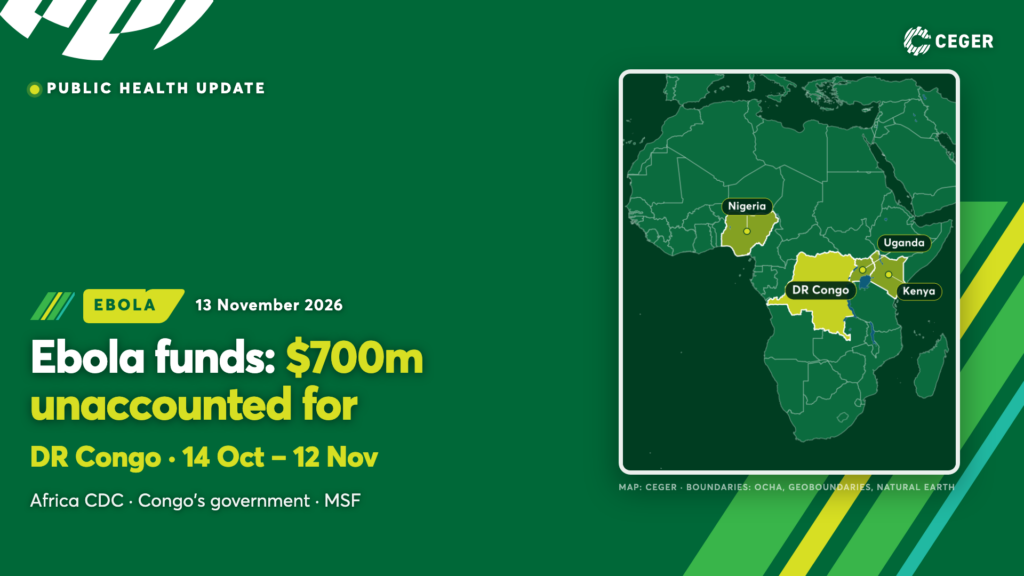
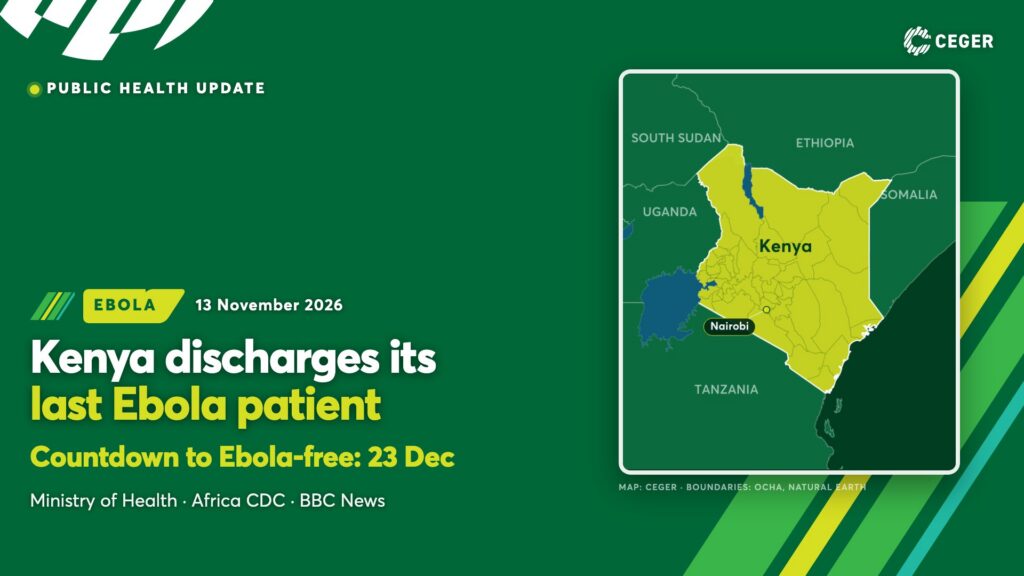
October showed how far the virus can travel. Kenya’s first case, a Kenyan citizen who had been living in DR Congo, travelled to Kenya through Uganda on 3 October and later died. A woman who flew from Uganda to Nigeria tested positive there on 20 October (ECDC). Uganda’s Ministry of Health says she had no symptoms when she left the country (Ministry of Health, 23 Oct), and all 60 contacts of the Kenyan case it traced in Uganda completed 21 days of monitoring without falling ill (Ministry of Health, 25 Oct). After those cases the ministry brought back passenger locator forms and barred travellers who had been in DR Congo from transiting through Uganda.
The outbreak next door
By 16 November DR Congo had reported 11,504 confirmed cases and 5,630 deaths, most of them in Ituri (7,911 cases) and North Kivu (2,925), the two provinces along Uganda’s border (ECDC). The outbreak is caused by the Bundibugyo virus, for which there is no licensed vaccine or treatment. Uganda’s own outbreak, between May and July, infected 20 people and killed two (Ministry of Health).
Schools: the background
The rules for learners build on a statement from the Ministry of Education and Sports dated 9 September. “Following a technical risk assessment, the Ministry of Health has directed that learners travelling from the DRC under the special school entry arrangement shall undergo supervised quarantine for 21 days before reporting to their respective schools in Uganda,” said its Permanent Secretary, Dr Kedrace Turyagyenda. Schools were asked to keep places for affected learners, to keep their status confidential and to prevent stigma (Daily Monitor).
Border schools have felt this since the start. In June, school administrators in Koboko asked the Education Ministry for help: many of their learners come from DR Congo, and several who commute across the border had not reported for the new term because some parents feared infection (NTV Uganda). Children carry a heavy share of the outbreak in DR Congo: UNICEF counts them as 28% of confirmed cases and 35% of deaths (ECDC).
What WHO says about travel restrictions
The outbreak has been a public health emergency of international concern since 17 May. WHO’s temporary recommendations for countries bordering DR Congo, Uganda among them, say: “Neither the suspension of flights or waterways routes with States Parties with community BDV transmission, nor denial of entry to travellers and conveyances arriving from those States Parties, are recommended.” The same recommendations ask DR Congo to stop cases and their contacts from travelling and to postpone mass gatherings where the virus is spreading (WHO, 24 Aug).
On 17 November, WHO’s Director-General, Dr Tedros Adhanom Ghebreyesus, told the Emergency Committee: “I remain concerned that some countries continue to apply blanket travel restrictions. They hinder the response, damage livelihoods and discourage countries from reporting outbreaks quickly. Targeted, evidence-based measures work better.” He did not name any country (WHO).
Uganda has made a similar argument itself. In June, when the United States, Canada and the United Arab Emirates restricted entry for travellers from Uganda, Dr Atwine said: “While we appreciate the need for vigilance, blanket restrictions undermine confidence in countries that report outbreaks openly, and are not commensurate with the actual risk” (Civil Aviation Authority; AFP via Citizen Digital). The measures of 19 November target undocumented travel, possible exposure and particular districts, not every traveller from DR Congo. How they work out for families, traders and schools on the border will be worth watching.
What to do
The ministry asks everyone to avoid contact with anyone showing signs of Ebola: sudden fever, headache, muscle pain, weakness, vomiting, diarrhoea or unexplained bleeding. Report suspected cases to the nearest health facility, or call the Uganda Ministry of Health toll-free line, 0800 100 066. Wash your hands regularly with soap and clean water.
We will update this post when the ministry publishes the full statement and the list of high-risk districts.
Sources
Online sources accessed on 20 November 2026.
- Emmy Daniel Ojara, Daily Monitor. Uganda threatens to sanction airlines, bans movement of learners from DRC in new Ebola measures. 19 November 2026.
- Bridget Nsimenta, Nile Post. Uganda Bans Mass Gatherings in Ebola-Prone Border Districts, Tightens Cross-Border Controls. 19 November 2026.
- Ministry of Health, Uganda. Statement by the Hon. Minister of Health on the progress in national Ebola preparedness and response efforts (PDF). 25 October 2026.
- Uganda Radio Network, via allAfrica. Uganda: Minister Ayume Calls for Patience As Uganda Keeps DRC Border Closed. 13 November 2026.
- European Centre for Disease Prevention and Control. Ebola disease outbreak caused by Bundibugyo virus, multi-country, 2026. 19 November 2026.
- Ministry of Health, Uganda (Prof. Charles Olaro, Director General Health Services). Update on the investigation involving a traveller to Nigeria and additional public health measures (PDF). 23 October 2026.
- Ministry of Health, Uganda. Uganda is officially Ebola free. July 2026.
- Daily Monitor. Gov’t orders mandatory 21-day quarantine for students travelling from DRC. 13 September 2026.
- Gladys Namyalo, NTV Uganda. Koboko schools seek urgent Ebola support as cross-border risk grows. 2 June 2026.
- World Health Organization. Second meeting of the IHR Emergency Committee on the epidemic of Ebola Bundibugyo virus disease in the Democratic Republic of the Congo: temporary recommendations. 24 August 2026.
- World Health Organization. WHO Director-General’s opening remarks at the third IHR Emergency Committee meeting on Bundibugyo virus disease epidemic in the Democratic Republic of the Congo. 17 November 2026.
- Uganda Civil Aviation Authority. Uganda’s Health Ministry Reassures Airlines of Robust Mitigation Measures in Relation to Ebola. June 2026.
- AFP, via Citizen Digital. Uganda slams ‘unfair’ Ebola air travel restrictions. 14 June 2026.
Cite this brief: Centre for Governance and Environmental Research (CEGER). 2026. Uganda Tightens Ebola Rules: Airlines Warned, Day Scholars From DR Congo Barred. CEGER blog, Kampala. https://ceger.org/blog/uganda-ebola-airlines-learners-measures/
Leave a comment