
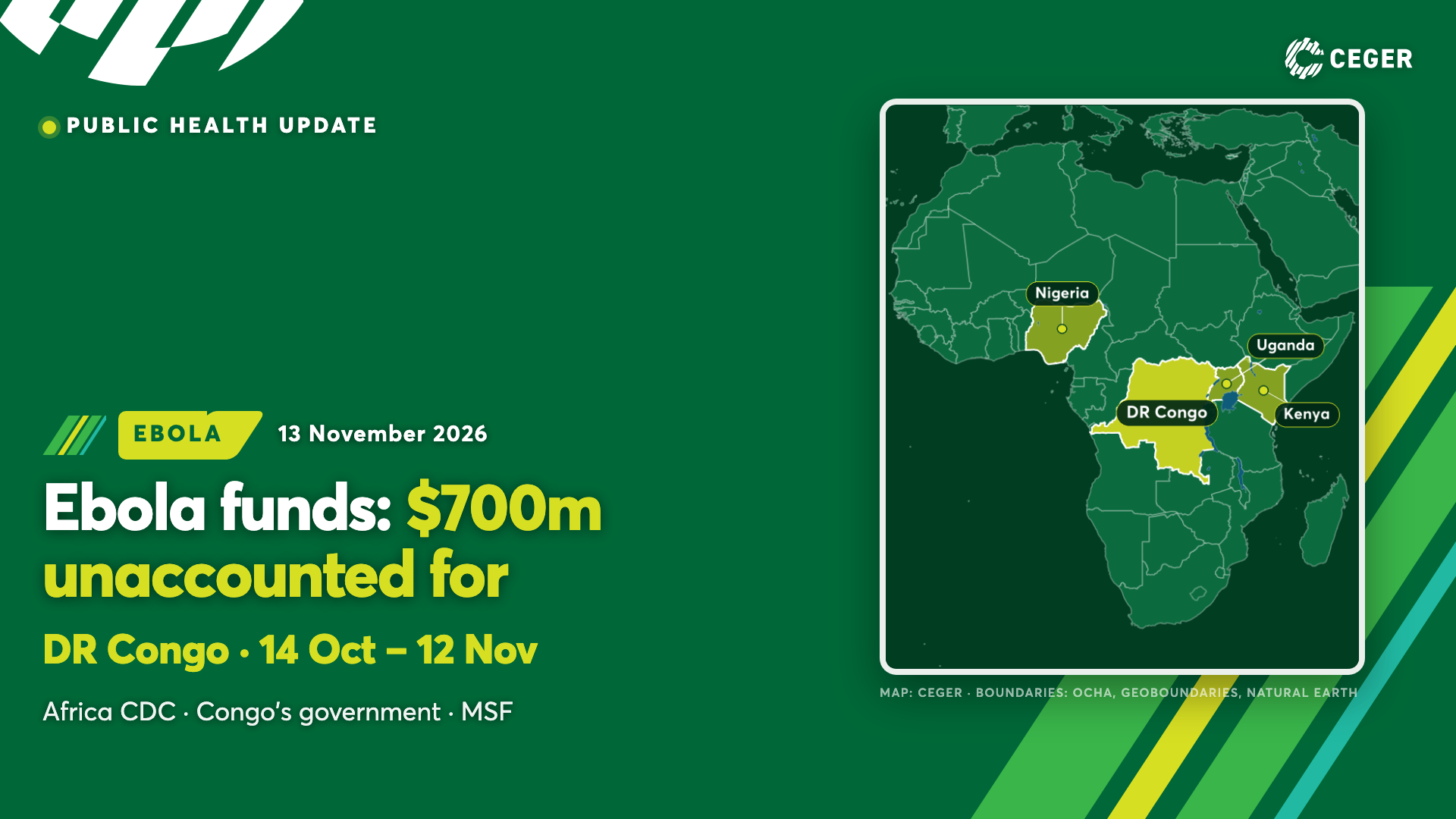
DR Congo’s Ebola outbreak, declared in May 2026, has killed more than 5,400 people and infected about 11,000, making it the second-deadliest Ebola outbreak on record (BBC News). It is caused by the Bundibugyo species of the virus, for which there is no approved vaccine or treatment, and cases have been reported in Kenya, Uganda and Nigeria. Six months in, two warnings point to the same problem: the money is there, but much of it cannot be traced and too little of it reaches the people fighting the virus.
$962 million sent, about $700 million unaccounted for
On 14 October in Kinshasa, Africa CDC said that of the $962 million donors had disbursed to organisations implementing the response, about $700 million could not be accounted for (AP; Reuters). Only about a third of the organisations came to the Health Ministry’s meeting with their records; those that did reported $228 million received and $127 million spent. Africa CDC did not name the others.
Its Director General, Dr Jean Kaseya, said it was too early to call this embezzlement, describing it instead as a major failure of transparency and financial reporting (BBC News). Africa CDC says it will investigate with the Congolese authorities.
What the government says
The government says it received no money directly from donors. “Our requirement is clear: transparency must be total. The response relies on a single plan, a single budget, and a single coordination,” the Minister of Public Health, Samuel-Roger Kamba, wrote on X, adding that only 22% of aid agencies had given the ministry details of their work (BBC News).
The Communications Minister, Patrick Muyaya, told AP: “The funds granted were not paid into the general treasury; we must know who received what.” The government has since re-accredited 25 of almost 100 organisations working on the response (AP).
MSF: the money is not reaching the front line
On 12 November Médecins Sans Frontières (MSF) reported that the outbreak remained “out of control” while response workers went unpaid, lacked training and ran short of supplies; some ambulances had run out of fuel (MSF). It described “surveillance teams that exist on paper but are nowhere to be seen on the ground”.
The gaps show in the figures. Close to two-thirds of reported Ebola-related deaths have occurred in communities rather than in treatment centres. In Ituri province, only nine per cent of the Ebola patients MSF treated had been identified as contacts beforehand, meaning most cases were not being found through contact tracing. MSF said the response was “too slow” in North Kivu, while Haut-Uélé remained “dramatically overlooked”.
“Our teams are often left speechless by the dysfunctions they witness in many areas. Six months into the response, this situation is simply unacceptable,” said Dr Javid Abdelmoneim, MSF’s International President.
Not the first time
Concerns about Ebola money in DR Congo are not new. In September 2019, during the 2018–2020 outbreak in North Kivu and Ituri, police arrested the former health minister, Dr Oly Ilunga Kalenga, over the alleged mismanagement of Ebola funds; he denied the accusation (BBC News). In March 2020 a court convicted him and the ministry’s financial adviser of embezzling more than $400,000 and sentenced both to five years’ forced labour. Ilunga said he had not authorised the payments and said he would appeal (Reuters).
That case belongs to a different outbreak. For the 2026 funds, no audit finding of misuse has been published, and the organisations that have not accounted for their money have not been named.
What happens next
MSF asks the government and UN agencies to strengthen oversight and accountability, to make sure responders are trained, paid, equipped and supported, and to direct resources to where needs are greatest, naming North Kivu and Haut-Uélé (MSF).
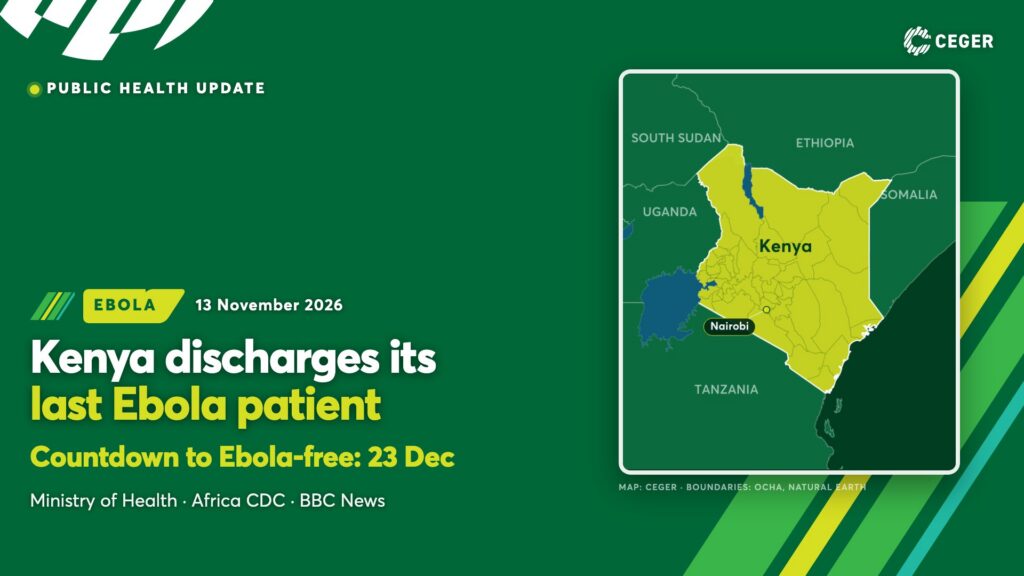
Three questions remain open. Which organisations have not accounted for their funds? What will Africa CDC’s investigation with the Congolese authorities find? And how quickly can money already disbursed reach the teams tracing contacts and running treatment centres? For Uganda and its neighbours, which have already had cases (Kenya discharged its last Ebola patient on 11 November), the answers matter: an outbreak that is not controlled at its source keeps borders, clinics and travellers at risk.
We will update this post as the investigation reports.
Sources
Online sources accessed on 13 November 2026.
- Basillioh Rukanga, BBC News. Millions of Ebola dollars missing with staff unpaid while virus spreads, charity says. 12 November 2026.
- Médecins Sans Frontières. Ebola in DRC: Persistent gaps between resources and action remain six months on. 12 November 2026.
- Monika Pronczuk, Associated Press (via KSAT). Millions of dollars are unaccounted for in Ebola response, officials say. This is what we know. 19 October 2026.
- Reuters. Africa CDC says over $700 million in Ebola response funds unaccounted for in Congo. 16 October 2026.
- European Centre for Disease Prevention and Control. Ebola disease outbreak, epidemiological update. 9 November 2026.
- BBC News. DR Congo ex-health minister arrested over Ebola funds. 14 September 2019.
- Stanis Bujakera, Reuters. Former DR Congo health minister convicted of embezzling Ebola funds. 23 March 2020.
Cite this brief: Centre for Governance and Environmental Research (CEGER). 2026. DR Congo’s Ebola Response: $700 Million Unaccounted For, and Frontline Workers Unpaid. CEGER blog, Kampala. https://ceger.org/blog/drc-ebola-funds-unaccounted/
Leave a comment