
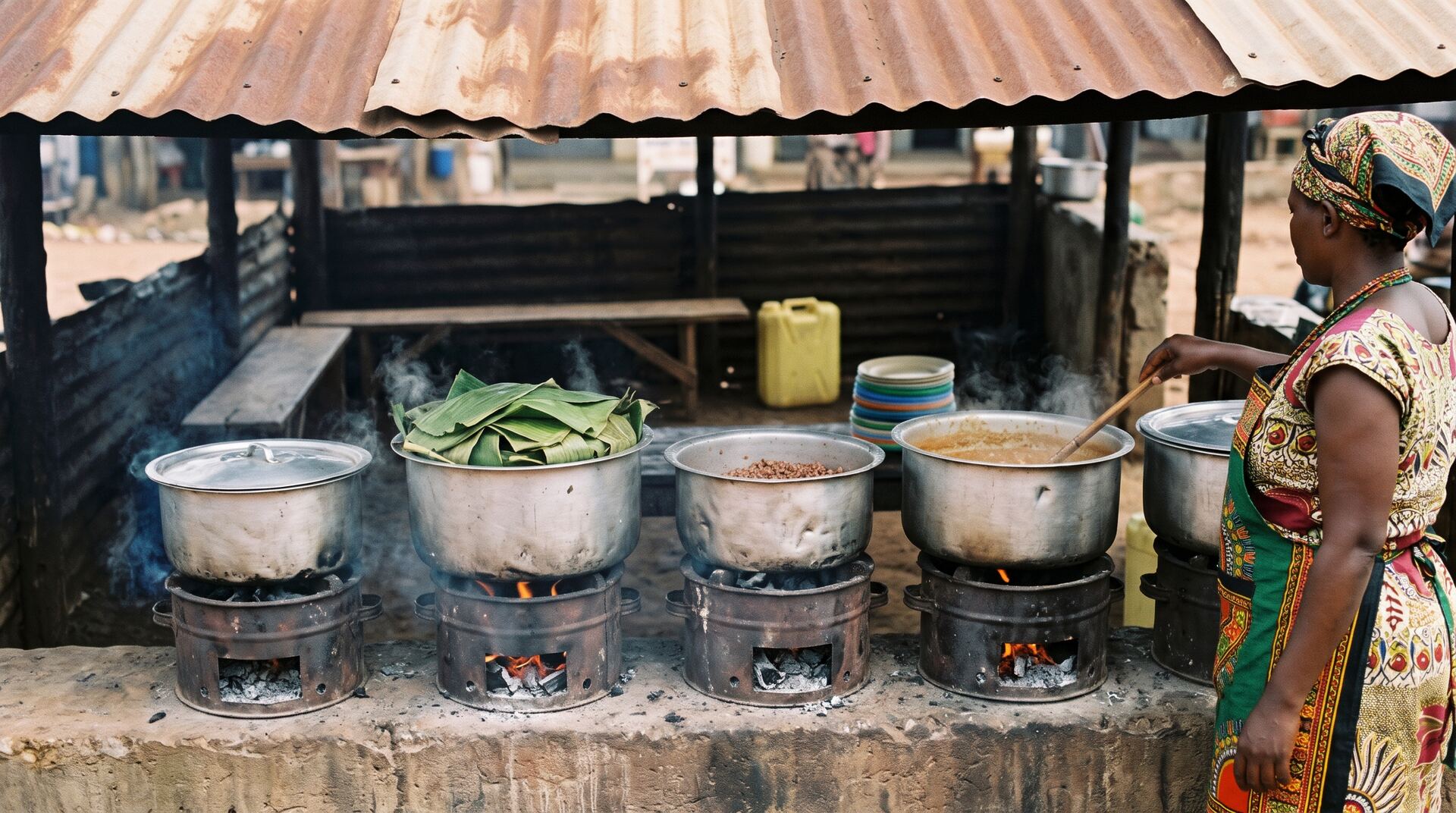
Walk past any trading centre in Kampala at lunchtime and you will find her. She runs a small cookery under an iron-sheet roof, with four or five charcoal stoves lined up along the wall. Matooke steams in banana leaves on one; beans simmer on another; posho, rice and a pot of groundnut sauce sit on the rest. By noon the cooking is done, but the stoves stay lit. The coals are banked low and left to glow for hours, because mashed matooke that cools hardens within the hour, and nobody pays for cold food.
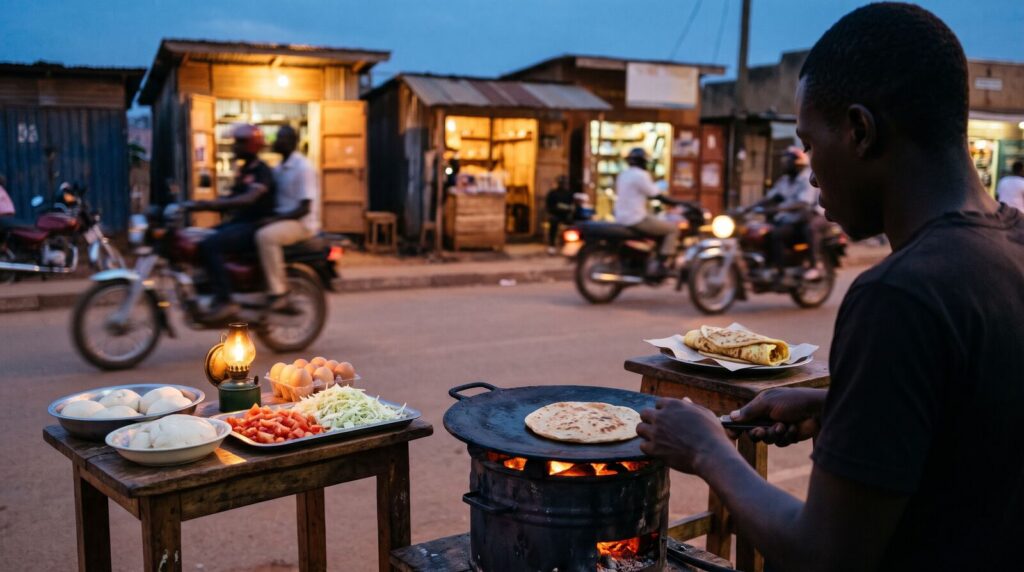
Down the road, a young man flips chapatis on a wide flat pan over a charcoal stove. Later in the evening, others will set up to fry mandazi and roast maize. They feed the boda riders, market traders and builders who cannot afford to eat anywhere else, and nearly all of them run on charcoal.
They are the people the national debate about the charcoal ban has largely skipped over. And they face the hardest sums.
What the ban actually says
The restrictions come from Presidential Executive Order No. 3 of 19 May 2023. It bans charcoal burning and trade in West Nile, Northern Uganda, Karamoja and Teso, the regions that supply much of the country’s charcoal. It is a supply-side measure. It does not ban anyone from cooking with charcoal, and it does not distinguish between households and businesses.
Enforcement was largely dormant until this year. In October, police seized hundreds of bags in Amuru and Pakwach and warned that even a single bag carried home on a pick-up would not be spared. On 14 October, Speaker Jacob Oboth suspended enforcement until the government explained how Ugandans are meant to cook without it. Two days later, the State Minister for Energy told Parliament that her ministry has no mandate over the ban, though it is promoting LPG, electric cooking, ethanol and biogas.
The statement Parliament asked for was due on Wednesday 21 October. It did not come. The next day, the Leader of the Opposition reminded the House that traders were stranded with charcoal worth about Shs2.4 billion at the borders while government said nothing about alternatives. The Government Chief Whip replied that the Energy Ministry would report on both the ban and the roll-out of alternative fuels, but first had to harmonise its position with the executive order and its author. The statement is now expected on Tuesday 27 October. In the same sitting, an MP from Koboko told the House that security agents in his district were confiscating charcoal from small sellers without explanation, even while enforcement was meant to be on hold.
So no one has told a Kampala food vendor to stop using charcoal. But a ban on supply reaches her anyway, through price. In Gulu, a bag that sold for Shs30,000–40,000 now fetches Shs60,000–80,000. The policy’s implicit message is: switch to something cleaner. The question is what that costs.
Why vendors are different
Most of the analysis so far has looked at households. About 28 per cent of Ugandan households cook mainly with charcoal, rising to nearly half (48.6 per cent) in urban areas, according to the 2024 census. Only 2.4 per cent of urban households use LPG.
Small food businesses differ from households in three ways that matter:
- They cook in volume, for many hours. A home cooks two meals; a cookery cooks for a lunchtime crowd and then keeps the food hot until it sells out.
- Fuel is a business cost. Every shilling more on fuel either comes out of a thin margin or goes onto the price of a Shs3,000 plate of beans that customers can barely afford.
- They do not qualify for the help on offer. The government’s discounted electricity cooking tariff applies only to domestic customers. A vendor on a business meter pays the full commercial rate.
The cost of switching: our analysis
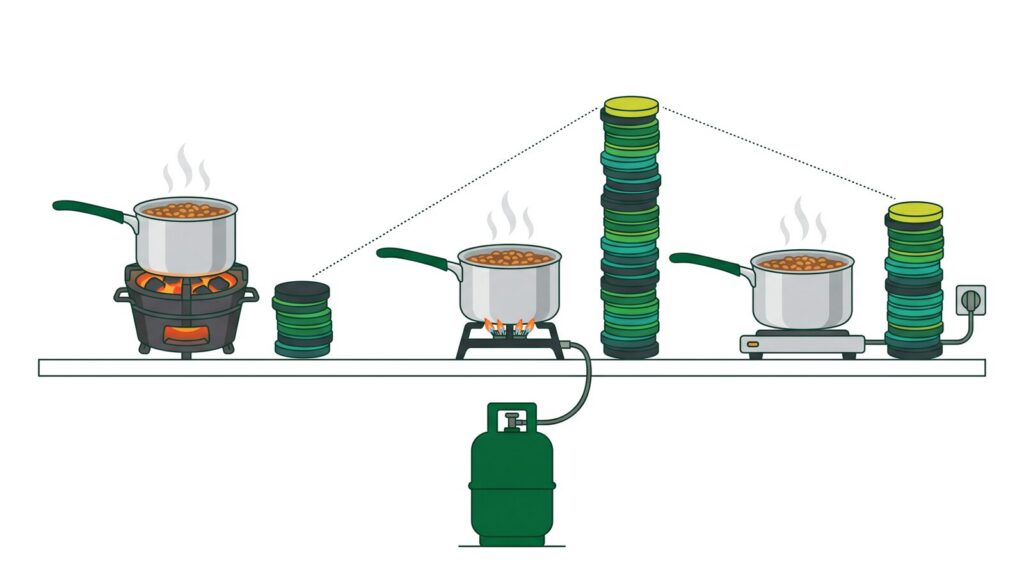
To compare fuels fairly, we cost the useful heat each one delivers into the pot, after allowing for how efficiently each stove uses its fuel. A charcoal stove wastes most of its heat; a gas burner or electric plate wastes much less. The figures below compare the cost of the same cooking on each fuel.
Our assumptions:
- Charcoal: Shs2,000 per kilo, burnt on an improved stove, which uses 35–50 per cent less charcoal than an ordinary one. Kampala’s cookeries widely use improved stoves: one carbon-finance programme alone has distributed more than 700,000 in and around the city.
- LPG: Shs112,000 for a 12 kg refill (Shell’s current price), about Shs9,300 per kilo.
- Electricity: the Electricity Regulatory Authority’s commercial tariff of Shs562 per kWh, plus 18 per cent VAT.
- Stove efficiencies: standard reference values used in clean-cooking research (MECS). These are charcoal 25 per cent on an ordinary stove, LPG 44–55 per cent and an electric hotplate 72 per cent.
On that basis, the same cooking costs:
| Fuel | Cost relative to charcoal on an improved stove |
|---|---|
| Charcoal, improved stove | 1.0× |
| Electric hotplate, commercial tariff | 1.4–1.9× |
| LPG | 2.1–3.3× |
Our method agrees with the most recent public comparison. Writing in the Daily Monitor this week, environmental specialist Dr Robert Ddamulira put the cost of useful heat at Shs336 per megajoule for gas, against Shs140–180 for charcoal on an improved stove. Our model reproduces his numbers exactly.
What this means for a real business
Last week The Observer spoke to two Kampala vendors. One, who runs a small eatery, spends about Shs30,000 a week on charcoal. The other, who sells chapatis and rolexes, spends about Shs50,000 every two weeks.
| Shs per month | Charcoal today | On LPG | On electricity |
|---|---|---|---|
| Small eatery | 130,000 | 273,000–429,000 | 182,000–247,000 |
| Chapati and rolex stand | 108,000 | 227,000–357,000 | 152,000–206,000 |
For the eatery, switching to gas means finding an extra Shs143,000 to Shs299,000 every month. The top of that range is more than the business currently spends on charcoal twice over. For a business already servicing three loans, as this owner is, that is not a transition. It is a closure notice.
Keeping food warm costs more on gas
The cookery’s long afternoon adds a further penalty. Charcoal is well suited to holding food: banked coals give off a low, steady heat for hours, and keep giving it after the fire is starved of air. A gas burner cannot do the same. Even on its lowest setting, a standard burner uses more gas than the pot needs to stay warm.
We estimate that holding four pots of food warm for six hours uses:
- about Shs3,100 of charcoal on improved stoves;
- about Shs8,800 of gas;
- about Shs4,400 of electricity, provided the power stays on.
Each of those hours is a matter of daily survival for the business, not convenience. Customers who find the matooke cold and hard do not come back.
The bigger barrier: getting started
The running cost is only half the problem. Before a vendor saves or spends anything on a new fuel, she has to buy her way in.
Equipment. A charcoal stove costs little. A new 12 kg gas cylinder costs about Shs266,000 before a single burner is bought, and a cookery running four or five pots at once needs more than one. An induction cooker costs around Shs220,000, so five come to over a million shillings. Induction also only works with iron or steel pots, which means replacing the aluminium sufurias that every cookery already owns.
Cash flow. Charcoal is bought the way these businesses earn: in small amounts, daily, from the morning’s takings. Gas is bought in lumps. At the eatery’s scale, a 12 kg cylinder would last about ten to thirteen days, so the owner would need Shs112,000 in cash at once, every week and a half. For a business that lives on daily takings, setting that sum aside is a real obstacle, and running out mid-service means turning customers away.
Power supply. Electric cooking assumes a reliable grid connection on site. Only 49 per cent of urban households have one. Many roadside stands and evening snack vendors have none at all. Running four or five electric plates at once also draws far more power than a small kiosk’s wiring is built for. And each power cut leaves the food to go cold.
The way food is cooked. Matooke steamed in banana leaves for hours, chapatis on a wide flat pan and food held on embers through the afternoon were not designed around a gas ring. Vendors can adapt, but adapting takes money and time they do not have.
A policy that works for vendors
Protecting Uganda’s forests is necessary. Uganda has lost more than 60 per cent of its forest cover since 1960, according to Maj Gen Keith Katungi, quoted in The Independent. But a supply ban that quietly prices the country’s food vendors out of their only affordable fuel will not save forests. It will push the trade underground, raise the cost of a cheap meal, and close businesses that are very often run by women.
We recommend the following.
- Put the policy on a legal footing. A measure with consequences this wide should be set out in law and debated in Parliament, with a defined scope and timeline, not left to an executive order whose enforcement starts and stops.
- Extend the cooking tariff to micro food businesses. The domestic e-cooking tariff (Shs412 per kWh for units 81–150) should have a commercial equivalent for registered small food vendors, so electricity can compete where the grid reaches.
- Finance equipment the way vendors earn. Pay-as-you-go repayment for cylinders, burners and induction cookers, in small daily amounts, could be channelled through existing schemes such as the Parish Development Model. Smaller 1–2 kg cylinders and metered “pay-as-you-cook” LPG would remove the lump-sum barrier.
- Treat improved charcoal stoves and legal charcoal as the transition, not the enemy. As Dr Ddamulira argues, licensed, traceable charcoal from managed woodlots, burnt on efficient stoves, cuts wood use now while cleaner fuels become affordable.
- Count the vendors. Policy cannot plan for a sector it cannot see. A simple survey of how many food vendors operate, what they cook and what they spend on fuel would tell government what a transition will actually cost.
The question Parliament should ask
When the Minister for Energy finally reports to Parliament, the question should not only be whether households have alternatives. It should be: what does a woman running a five-stove cookery do on Monday morning? Until there is a credible answer, one she can afford, a ban on charcoal is a ban on her business.
This analysis is based on published prices and standard efficiency values. Actual costs vary with the stove, the cooking and the price paid for fuel. CEGER welcomes data from vendors, suppliers and researchers to refine these estimates. The images in this article are illustrations and do not show real people or businesses.
Sources
- The Independent, Uganda Police declares another war on charcoal, 12 October 2026
- Pan African Visions, Speaker halts charcoal trade ban pending Govt statement, October 2026
- Daily Monitor, Energy Ministry lacks mandate to address charcoal ban, says minister Nyamutoro, October 2026
- Daily Monitor, Don’t ban charcoal, make it sustainable, Dr Robert Ddamulira, 23 October 2026
- The Observer, How a ban on charcoal threatens survival for urban vendors, 21 October 2026
- The Observer, To replace charcoal, govt should promote gas cylinders of 1kg, 2kg, 21 October 2026
- Parliament of Uganda, plenary sitting of 22 October 2026 (video recording)
- Nile Post, Charcoal ban raises questions over affordable cooking alternatives, 19 October 2026
- NTV Uganda, Uganda’s charcoal ban sparks mixed reactions, 23 October 2026
- MECS, Enhancing Subnational Planning for Accelerating the E-Cooking Transition: Uganda, October 2026
- MECS, Stove efficiency is only half the story, January 2025
- Electricity Regulatory Authority, ERA approves electricity tariffs for the third quarter of 2026 (retained for Q4)
- Shell Uganda, Shell Gas pricing
- First Climate, Uganda: energy-efficient cookstoves

Leave a comment